In his new column, Bruno Tariki, from Itaú Asset, answers a question that is very frequent when the S&P 500 breaks new record highs: does it make sense to invest at the current price?
The S&P 500 recently reached a new all-time high, trading at 7,600 points for the first time. This valuation is impressive considering that a year ago, the index was at 5,900; five years ago, at 4,200; and ten years ago, at 2,100.
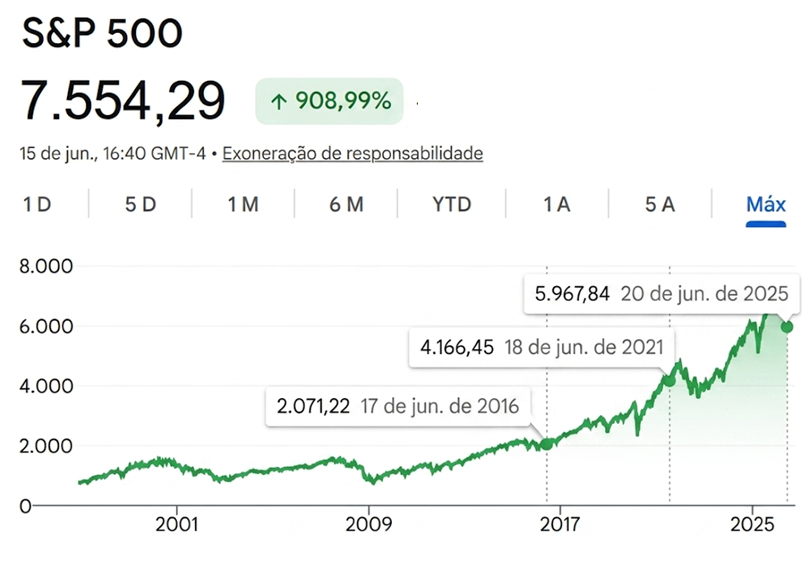
Source: Google Finance
Every time the S&P 500 hits a new record, the same question arises: “Is it too expensive now? Shouldn’t I wait for a correction to enter?” It is a natural impulse, and almost always mistaken.
New highs are not a sign of a market top, meaning that the next move will be profit-taking by investors and a resulting price correction. Analyzing the history of the S&P 500 since 1950, buying at historic highs delivered positive returns superior to other entry points across most time horizons.
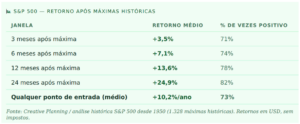
Fonte: Creative Planning e Itaú Asset
The risk for a large portion of investors is the temptation of market timing. Buying at the low and selling at the high is not the goal when investing. Be careful: today’s high might be tomorrow’s low!
A suitable portfolio is more relevant than hitting the entry price
The allocation decision should place far more value on the whole than on the price level at which one enters an investment. The relevant question is not “is the index expensive?”, but rather, “is the portfolio suitable for the goal, investment horizon, and risk tolerance?”
Historical data and allocation logic suggest that this waiting can cost more than volatility itself. Investors who stayed on the sidelines waiting for a “better time” to enter the S&P 500 in 2023 missed out on +16%. Those who waited in 2024 missed +62%; in 2025, they missed out on +3% of S&P 500 gain (return in BRL). With each year spent waiting for the perfect correction, the opportunity cost accumulates—silently, but irreversibly.
What vehicles are available for exposure to the S&P 500?
For those seeking exposure to the S&P 500 via ETFs in Brazil, there is also a second relevant decision: currency-hedged or unhedged. Same asset, but different returns. And the return difference is material: SPXR11 accumulated +44.7% between January 2025 and May 2026, while SPXI11 reached +5.3% in the same period..
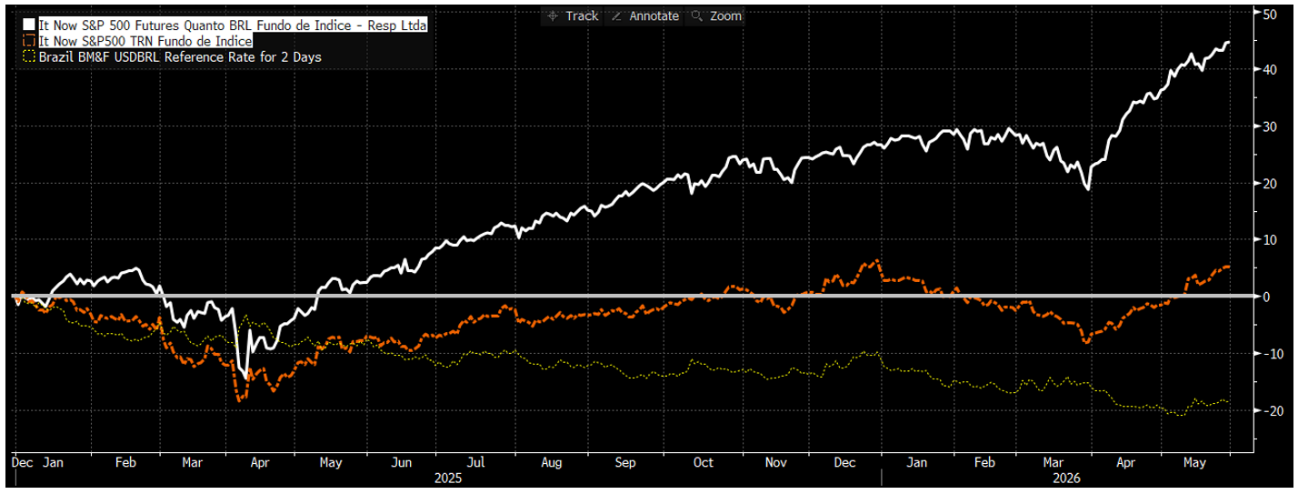
Source: Bloomberg
The reason is foreign exchange: the Brazilian real appreciated ~18.5% against the US dollar during this period, eroding SPXI11’s return. In SPXR11, the hedge eliminates this currency effect and captures the interest rate differential between Brazil and the US, approximately 9% per year, as an additional return.
Each product serves a thesis: SPXR11 for those who want the S&P 500 in BRL without currency risk; SPXI11 for those who want dollar exposure.
Focus on the focus!
The outlook remains positive for the companies that make up the S&P 500, which will likely continue to hit new highs; there will also be moments of correction, inherent to an asset with volatility. Investors who keep waiting for the perfect moment will miss more opportunities than they will capture corrections.
And don’t forget: what defines long-term results is not the entry price level; it is having a portfolio with a clear objective, diversified, efficient, low-cost, and suited to risk tolerance. A portfolio like that survives corrections, captures all-time highs, and delivers results regardless of entry timing and without relying on forecasts.