

Itaú Asset’s ETF Week reached its sixth edition, and the opening featured heavyweights like Gustavo Cerbasi and Marília Fontes discussing the evolution of the local ETF market in Brazil. We had the opportunity to attend the event and bring you the main insights. Additionally, Itaú Asset introduced another innovation to B3: CDIB11, another Fixed Income strategy from the manager.

The evolution of the Brazilian ETF market is undeniable. At last year’s event, the local industry held approximately 50–60 billion BRL in assets under management. Twelve months later, we see an industry that has doubled in size, with the number of investors getting closer to the 1 million mark.
We see an industry attracting attention from both investors and allocators, yet a significant educational gap remains. Furthermore, the maturation of this ecosystem requires a mindset shift, and the latest edition of ETF Week brought deep reflections on the role of financial psychology in decision-making and the transition from a market focused on short-term bets to truly structured planning.
Behavior and the End of “Investing as Gambling”
Historically, local investors have reacted to herd behavior and loss aversion in a reactive manner. During the event, Gustavo Cerbasi perfectly highlighted this scenario of “conflicted financial education,” where marketing and algorithms deliver seductive quick-fix solutions, leading Brazilians to treat investing as gambling. Because we are not strategically trained for the long term, active management topics often attract more attention, creating the illusory notion that active investing is inherently smarter.
However, index funds emerge as a mature and appropriate solution for those who do not have time for active management. Cerbasi noted that the best ETF should not be evaluated solely by considering the investor’s profile (conservative, moderate, or aggressive), but rather their financial goal, given that it is a vehicle that provides protection. Carlos Constantini, Executive Director of Wealth Management & Services at Itaú, complemented this view by reinforcing that as we achieve greater financial literacy, the adoption of ETFs grows naturally.
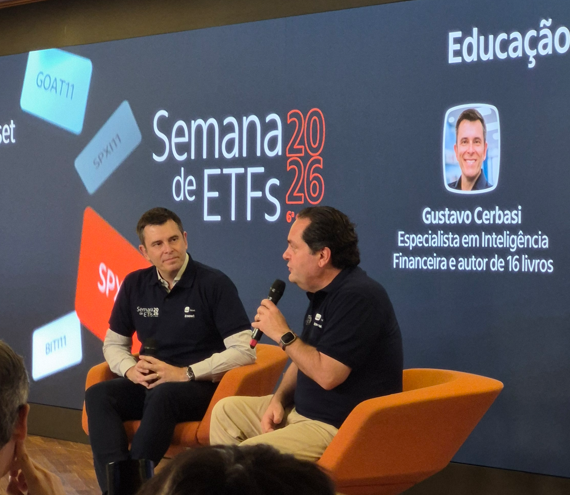
Gustavo Cerbasi and Carlos Constantini addressing financial literacy on the panel
Efficiency Meets Financial Planning
Much of the value of allocating via ETFs lies in behavioral economics. Paulo Costa, Senior Manager and Behavioral Economist at Vanguard, divided the client-advisor relationship into four fundamental pillars: client portfolio, financial planning, emotional value, and time. According to him, over 80% of clients initially seek help with portfolio construction, but what keeps them loyal to the structure is emotional value—translated into peace of mind. In this context, ETFs transcend the simple pursuit of returns, as they allow advisers to add emotional value while saving the investor time.
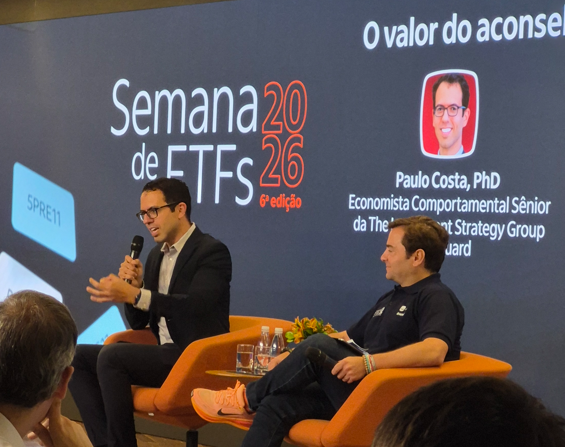
On the left, Paulo Costa. On the right, Renato Eid
For major allocators, the thesis is identical. Sylvio Castro, Head of Global Investments and Funds of Funds at Itaú, pointed out that ETFs naturally emerge as the cheapest and most efficient way to gain exposure to a theme without needing to pick individual stocks. When the fee model centers on service provision, the search for efficient strategies fits like a glove, generating allocations of around 2 billion BRL in just 11 months within Itaú’s managed accounts.
Fixed Income as a Growth Engine
Institutional expansion and access for new investors—such as the younger generation, which has been adopting index funds more heavily due to time and capital constraints—pave the way for the next major cycle. And this cycle is closely linked to fixed income.
Castro emphasized that where the ETF industry will be in the future depends heavily on the fixed income market. The domestic market has the capacity to learn from mistakes made abroad, and given that Brazilian investors have a strong fixed-income DNA, Arthur Carasso, Head of Global Private Investment at Itaú Private Bank, pointed out that this industry has huge potential to capture flow and double well before 2030. Filipe Portella, Co-founder and CEO of Monte Bravo, corroborated this outlook, observing growing education on the part of investors along the way.
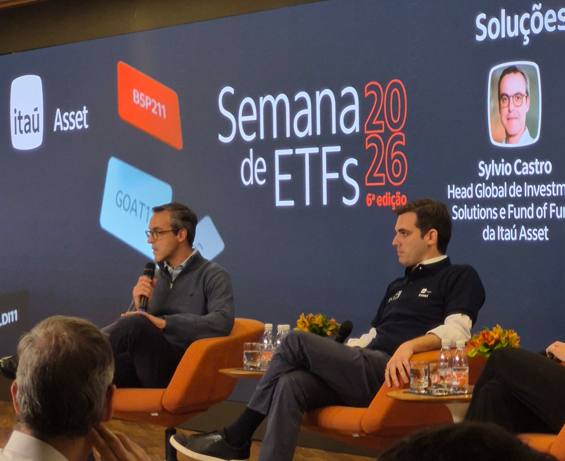
On the left, Sylvio Castro, and on the right, Arthur Carasso
CDIB11: The 11th Player on Itaú Asset’s Fixed Income Team
The evolution of exchange-listed fixed income culminates in practical innovations for portfolio structuring, specifically filling the space for more defensive allocations. A recent launch embodying this market quest for maximum efficiency is CDIB11.
Presented during ETF Week as a true “defensive player,” this vehicle is the manager’s 11th fixed income ETF and its 33rd overall, positioning itself as the most conservative ETF on its shelf. The fund seeks to track the CDI rate, with potential for excess return, in a very straightforward manner. To achieve this goal, CDIB11 tracks the ITBR SELIC 800 Index (Teva ITBR Selic Target 800 Index), developed by Teva Indices.
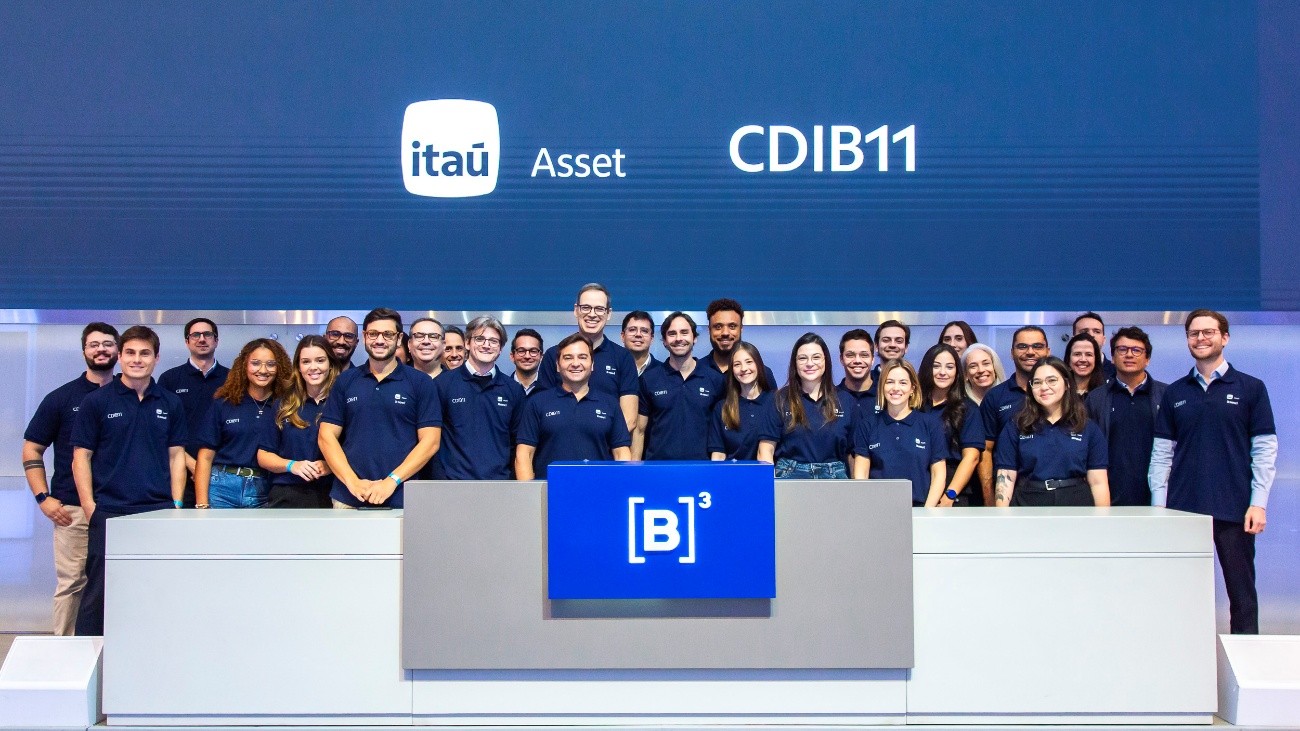
Ring the Bell ceremony held at B3 on Tuesday (June 9) for the launch of CDIB11
The index combines longer-dated LFTs (around 90% of the fund) and NTN-B 2060, aiming to maintain the portfolio’s average term at 800 days—above the 720 days required for a flat 15% income tax rate in a fixed income ETF.
In the “country of fixed income,” investors gain another opportunity to access fantastic tax efficiency: CDIB11 offers a flat 15% income tax rate on capital gains, with total exemption from Financial Operations Tax (IOF) and no semi-annual tax drag (come-cotas).
CDIB11 has an initial share price base of R$ 50 and a management fee of 0.15% per year.


