In his debut column, Bruno Stein, partner responsible for ETFs at Galápagos Capital and famous for coining the phrase “Heading to a trillion,” uses facts and data to defend his thesis that the Brazilian ETF market will reach the trillion-Real mark before 2030.
In January of this year, I publicly wrote that the Brazilian ETF industry would reach R$ 1 trillion before 2030. The market closed 2025 at R$ 90 billion. Four months later, it stands at R$ 118 billion.
Beyond simply updating the number, it is worth laying out the rationale behind the forecast—because it has grown stronger, not weaker.
The central argument
The net assets under management (AUM) of the Brazilian ETF industry more than doubled over the last twelve months. In April 2025, it stood at R$ 56 billion. By April 2026, it reached R$ 118 billion—a 111% growth rate in a single year.
The path to R$ 1 trillion does not rely on a complex, highly speculative projection. It depends on a straightforward question: if the industry continues to double every twelve months, when does it hit R$ 1 trillion?
The math is simple:
-
R$ 236 billion in April 2027
-
R$ 472 billion in April 2028
-
R$ 944 billion in April 2029
Under this trajectory, the industry crosses R$ 1 trillion in mid-2029, well ahead of 2030.
The forecast does not require doubling to happen at this exact pace indefinitely. It simply requires the current momentum to be sustained. And the 2026 data suggests that it will.
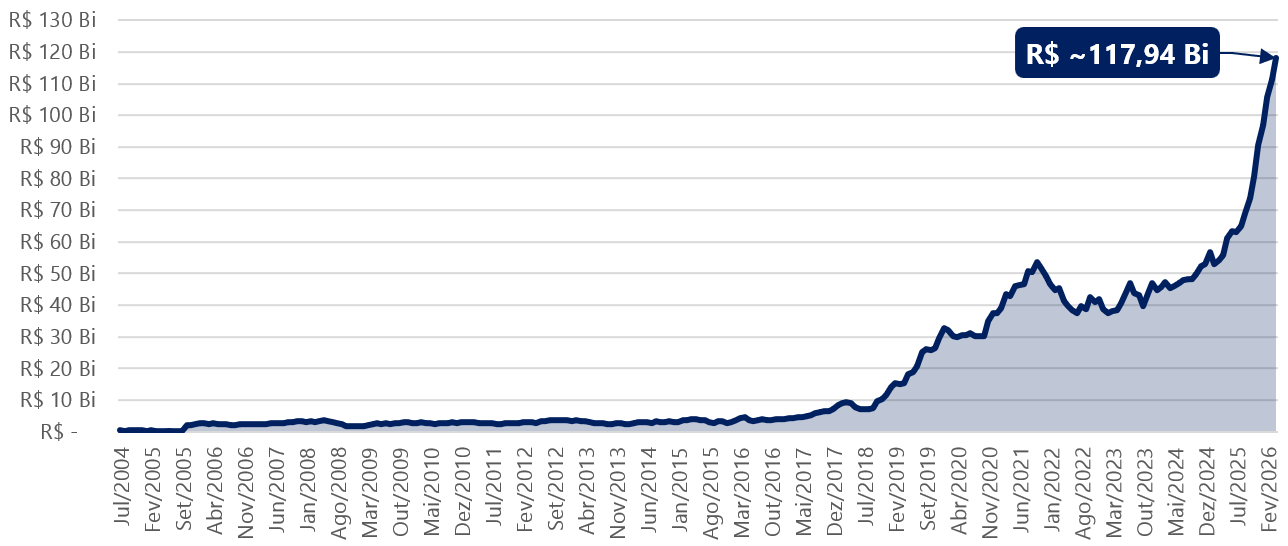
Net assets (AUM) of the Brazilian ETF industry, in R$ billions (Jul/2004 to Apr/2026). Source: B3/Quantum.
What lies beneath the growth?
Assets under management is the headline metric, but net inflows represent the most revealing indicator because they eliminate asset appreciation effects and reflect actual new capital coming in.
In all of 2025, the industry captured R$ 21.9 billion in net inflows. In the first four months of 2026 alone, it has already captured R$ 23.1 billion—surpassing the entire previous year in less than a third of the time. January, February, and March 2026 were the three highest net inflow months in the history of the Brazilian ETF industry.
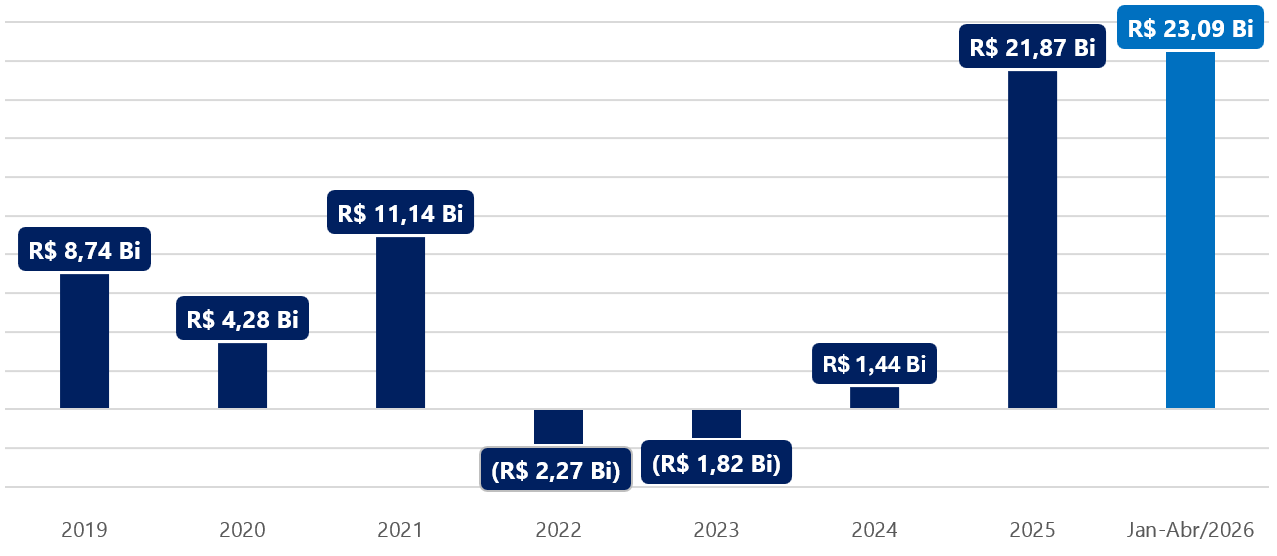
Annual net inflows of the Brazilian ETF industry, in R$ billions (2004 to Apr/2026). Source: B3/Quantum.
The investor count confirms this trajectory. According to B3’s April Monthly Bulletin, there were 242,000 ETF unitholders in Brazil at the end of December 2020. By April 2026, the count reached 854,000—more than tripling in just over three years. Meanwhile, the number of active products expanded from 88 to 195 over the same period. A broader product shelf solves more problems for a wider range of allocators, significantly expanding the addressable market.
What 2022 and 2023 reveal
It is worth looking back before looking forward. In 2022 and 2023, the Brazilian ETF industry recorded negative net inflows; the market bled capital for two consecutive years. Even so, the total number of unitholders continued to grow consistently throughout that entire period.
This metric matters because it demonstrates that the current expansion is structural. The investor base was actively forming even while total assets were temporarily retreating. When structural catalysts aligned—clear tax advantages in fixed income ETFs, the acceleration of the fee-based advisory model, and shelf expansion—the accumulating capital mobilized at historical speed.
The growth seen in 2025 and 2026 did not appear out of thin air. It stemmed from a foundation built consistently across challenging years.
Conclusion: The forecast holds
R$ 1 trillion before 2030 is the scenario where current momentum is maintained. The first four months of 2026 did not weaken this thesis. They reinforced it.