The NASDAQ-100 is structurally superior, delivers consistently, and yet remains underutilized by Brazilian investors. In his new column, Danilo Gabriel presents a diagnosis and a roadmap for Brazilian investors.
There is an uncomfortable detail in the portfolio of Brazilian investors: when they buy the local index, they are buying the picture of an old economy. The Ibovespa is, in practice, a commodities, banks, and energy index. Nothing against these sectors, but it is important to know what you are buying. And what you are buying here are sectors with little structural innovation.
Brazil invests in the past
Fonte: XP Asset
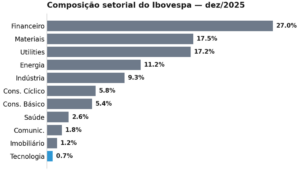
The numbers leave no doubt. In December 2025, Financials, Materials, and Energy accounted for about 56% of the Ibovespa. Technology? Less than 1%. The five largest stocks (Vale, Itaú, Petrobras, Bradesco, and Eletrobras) are the same faces that have dominated the index for decades; three of them were already in the top 5 in 2015. It is an index that captures a good picture of the Brazil we have today, but captures almost nothing of the economy being built globally.
An index that renews itself, another that crystallizes
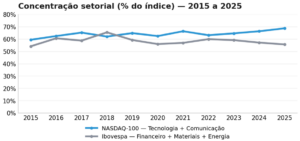
Here lies the difference that matters, and it is not about concentration. Both indices concentrate around 60%: both the NASDAQ-100 and the Ibovespa have nearly 35% in their top five holdings. The point is different: concentrated in what, and whether leadership rotates.
Fonte: XP Asset
The NASDAQ-100 renews itself. Nvidia jumped from outside the top 5 into first place; names like Yahoo, Activision, and Xilinx simply left the index. The Technology and Communication share rose from ~59% to ~69% over the last decade, showing that the index not only leads innovation, but deepens its commitment to it. The Ibovespa takes the opposite path: locked at ~56% in the old economy while keeping the same names. One index promotes tomorrow’s leaders; the other preserves yesterday’s incumbents.
Renewal turns into performance — and consistently
Renewal is not just interesting in theory. It turns into returns.
Fonte: XP Asset
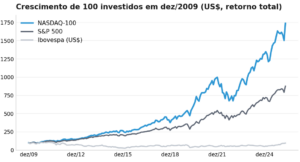
From December 2009 to April 2026, in US dollars and total return, the NASDAQ-100 delivered +1,639% (19% per year). The S&P 500, +776% (14% per year). The Ibovespa, in dollars, lost value: −4% over sixteen years. Holding cash US dollars “under the mattress” would have been better than investing in Brazil’s benchmark stock index.
And before objections arise such as “but over the last twelve months Brazil went up more”, the NASDAQ-100 presents an even stronger argument. It is not luck from a single period. Looking at all rolling windows since 2009, the NASDAQ-100 outperformed the Ibovespa in 80% of 12-month windows and in 100% of 5-year windows, without a single exception. The average return over a five-year window was +141% for the NASDAQ versus virtually zero for the Ibovespa. Against the S&P 500 itself, the NASDAQ won in 76% of 12-month windows and, once again, in 100% of 5-year windows.
In other words: even compared to the most commonly used gateway to the US, the S&P 500, the NASDAQ-100 returned virtually double. It is the right gateway.
The product: how Brazilians access it
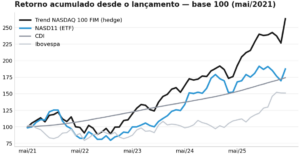
This exposure is available in Brazil, listed, starting from R$ 10. NASD11 was the first NASDAQ-100 ETF on B3. For those who prefer a currency-hedged version, there is the Trend NASDAQ 100 FIM, with hedge.
Fonte: XP Asset
Both vehicles beat local benchmarks since launching in May 2021: the hedged FIM returned +163%; NASD11, +87%; against +74% for the CDI and +51% for the Ibovespa. It is worth understanding the mechanics: the ETF delivers “unhedged” exposure, including foreign exchange, serving as the dollar-exposed gateway in hard currency. Meanwhile, the FIM, by hedging currency in a high-interest country, captures the NASDAQ plus the hedge carry, which is why it surged. They are two doors to the same destination, and investors choose theirs.
Adoption follows suit: NASD11 went from 18 thousand to approximately 49 thousand unitholders and from R$ 154 million to ~R$ 800 million in assets under management, continuing to attract net inflows even during the dollar drop of 2025 and 2026. That is conviction in the thesis, not opportunistic flows.
The size of the opportunity
Fonte: XP Asset
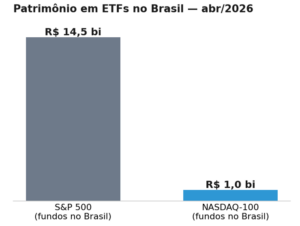
And here is the point that draws the most attention. Brazilian appetite for US investments already exists and is massive. However, it is almost entirely in the S&P 500. S&P 500 ETFs in Brazil account for about R$ 14.5 billion, while NASDAQ-100 ETFs account for approximately R$ 1 billion. The NASDAQ is only 6.6% of the S&P’s size here, despite returning double over a long horizon. To put that into perspective: the country’s largest S&P ETF alone is about seven times larger than the entire Brazilian NASDAQ-100 market.
A better index at a fraction of the size. It is not a demand problem; it is a penetration challenge. And where there is such a gap between quality and adoption, there is room to grow.
The final takeaway
In the end, it is simple. The next decade of returns tends to come from where innovation happens, and the NASDAQ-100 index certainly has the potential to capture that movement. It renews itself, performs consistently, and outperforms even the most popular American alternative. What remains is closing the gap between what the index delivers and how much Brazilian investors utilize it.