
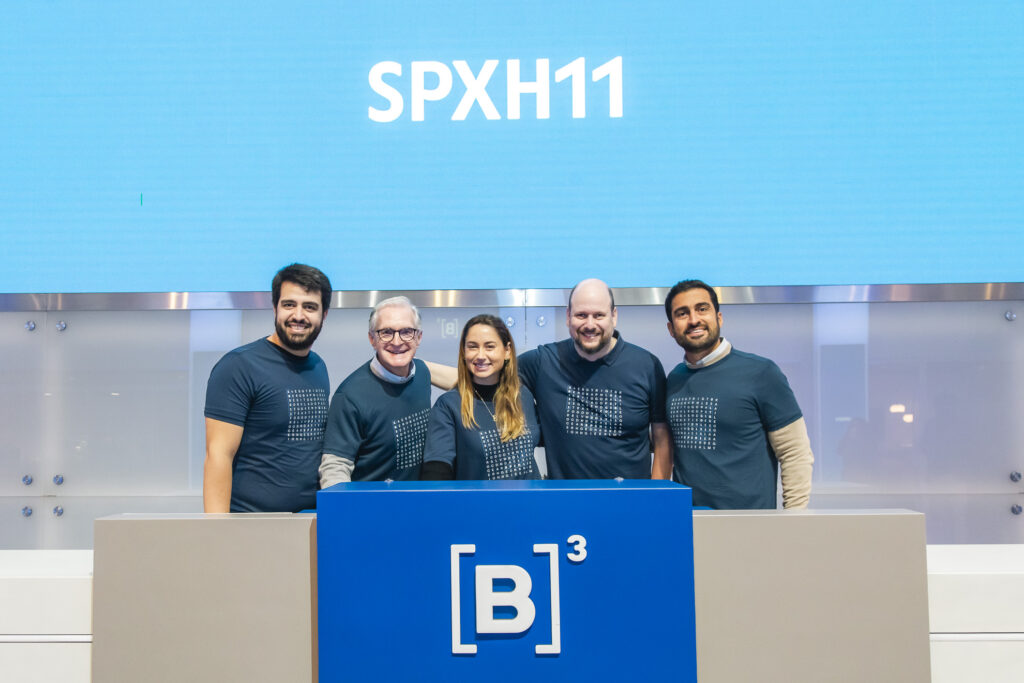
Last Friday we had the opportunity to participate in the Ring the Bell ceremony for XP Asset’s two new ETFs, SPXH11 and SPXU11. Two ETFs providing exposure to the 500 largest US companies, without and with currency exposure, respectively.
International diversification is no longer a differentiator and has come to be seen as a vital pillar for any investor’s portfolio. In the domestic scenario, the S&P 500 has already established itself as the benchmark with the highest number of unitholders in the Offshore Equities segment, surpassing even commodity ETFs and certain Ibovespa-based funds. Globally, the index’s relevance is massive, serving as a benchmark for around US$ 23 trillion in assets.
For Brazilian investors, however, accessing this market traditionally adds two risk factors to the table: market risk (the stocks in the index) and currency risk (dollar fluctuations). Since currency volatility is typically higher than that of the S&P 500 itself, the ability to segregate these factors becomes crucial to optimizing returns. It is with a focus on reducing these frictional costs and refining efficiency that XP Asset revamped its lineup with the SPXU11 and SPXH11 ETFs.
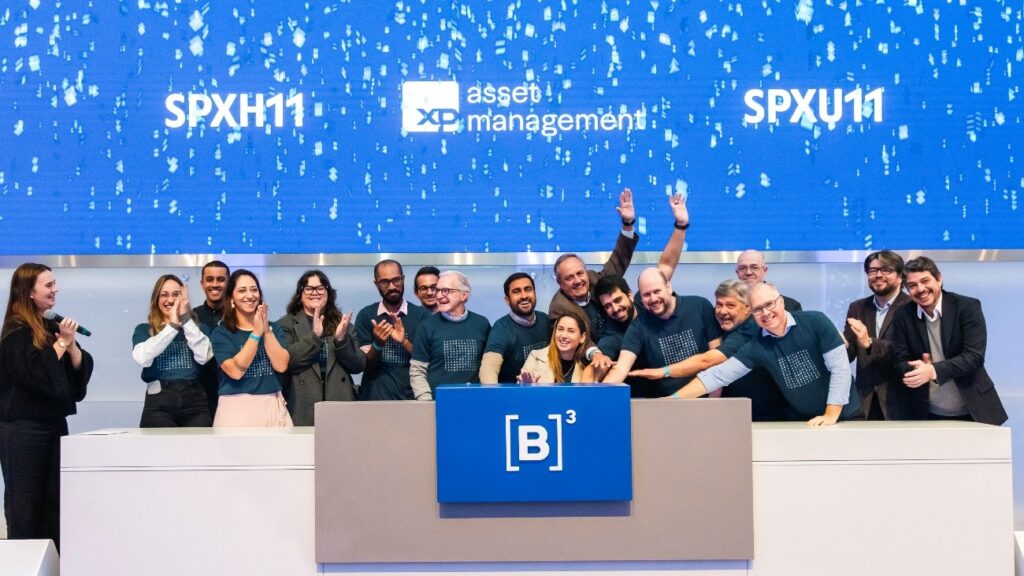
Ring the Bell held last Friday, June 26, to celebrate the launch of the SPXH11 and SPXU11 ETFs
SPXH11: Isolating the currency and capturing the interest rate differential between Brazil and the United States
For investors seeking to neutralize US dollar volatility and focus strictly on the performance of the index’s companies, the alternative is SPXH11’s currency-hedged strategy. The product enters the market proposing greater cost efficiency compared to existing peer options.
The major advantage of currency hedging using local derivatives in the Brazilian context goes beyond canceling out dollar fluctuations: the operation captures the interest rate differential between Brazil and the United States.
Historical data reveals the impact of this dynamic. The return from this interest rate differential recorded an annual average above 7%, and in the historical windows observed, the hedge effect was responsible for more than doubling the cumulative nominal return compared to the full index without protection (S&P 500 Net Total Return Index).
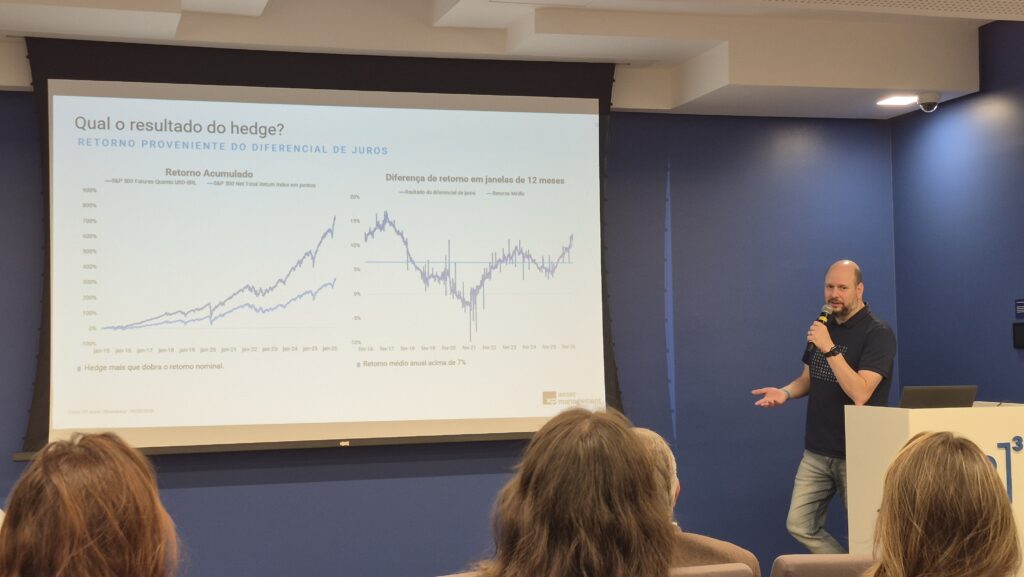
Leonardo Vasques, portfolio manager at XP Asset, on a panel following the Ring the Bell
SPXU11: Currency Exposure via Local Futures Market
SPXU11 emerges as a revamp of the former USAL11 ETF. The main change in methodology lies in eliminating traditional foreign exchange operations to send funds abroad. Instead, the fund adopts a strategy based on local instruments, utilizing highly liquid mini-contracts (such as WSP and WDO), keeping the portfolio 100% in domestic assets.
The core goal is to replicate the performance of the S&P 500 Futures USD-BRL Currency Exposure Index, a version developed by S&P specifically for this purpose. In practice, the vehicle allocates to cash, S&P futures, and dollar futures. This financial engineering brings direct differentiators to profitability. The first is operational cost reduction. Due to the ETF’s structure, there is no need for an external custodian, offshore invested funds, or executing conventional FX transactions.
Furthermore, investors have strong return expectations. They remain exposed to the exact same risk factors (US stock market and US dollar), but historically, the futures contract-based index has demonstrated superior performance compared to direct stock investment in the traditional format.
Utilizing this local ETF structure for dollar exposure also proves efficient when compared to direct allocation in offshore fixed income. This ETF format eliminates FX spreads (which abroad usually range between 1% and 2%) and the 1.1% IOF tax. In addition, there is no distribution of taxable monthly coupons; the 15% income tax collection occurs exclusively at the time of sale via DARF, avoiding the bureaucracy of the Annual Adjustment Declaration required for offshore assets.
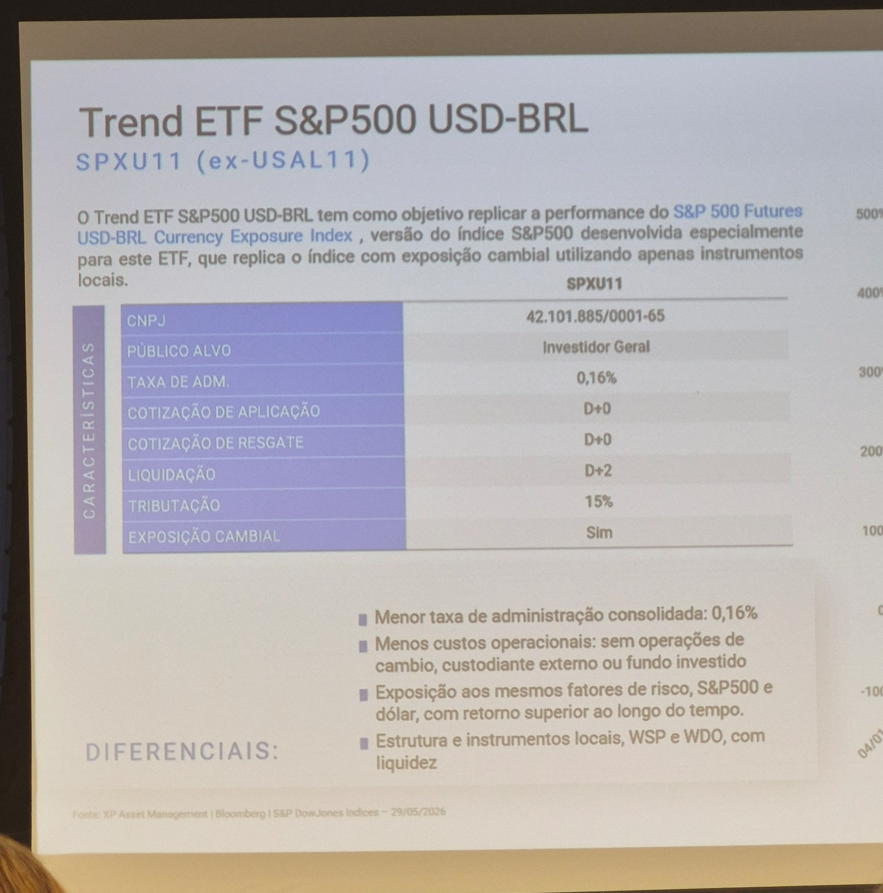
SPXU11 presentation panel
Conclusion: Two sides of the coin
With this, Brazilian investors gain two more ways to gain exposure to the world’s primary market: a dollarized strategy and another that shields the investor from currency risk. Two access points allowing investors to choose whichever makes the most sense for their risk profile and objective.
In the face of a local ETF market with scalable potential in strategies and inflows over time, the sophistication of these vehicles consolidates more efficient pathways for Brazilian investors’ international allocations.


