
Investo announced the launch of BNKS11, B3’s first ETF (Exchange Traded Fund) with an exclusive focus on financial institutions in the Brazilian market. The new asset aims to replicate the performance of the B3 Brazil Banking Index (Índice Bancos Brasil B3), offering investors a way to gain exposure to the sector’s leading companies through a single exchange-traded fund.
Index Composition and Criteria
BNKS11’s portfolio is composed of banks of various sizes and operating profiles. The portfolio brings together institutions such as Itaú Unibanco (ITUB4), Banco do Brasil (BBAS3), BTG Pactual (BPAC11), Bradesco (BBDC4), Banrisul (BRSR6), ABC Brasil (ABCB4), Banco Pine (PINE4), and BR Partners (BRBI11). Below is the consolidated breakdown of each company’s share in the new ETF.
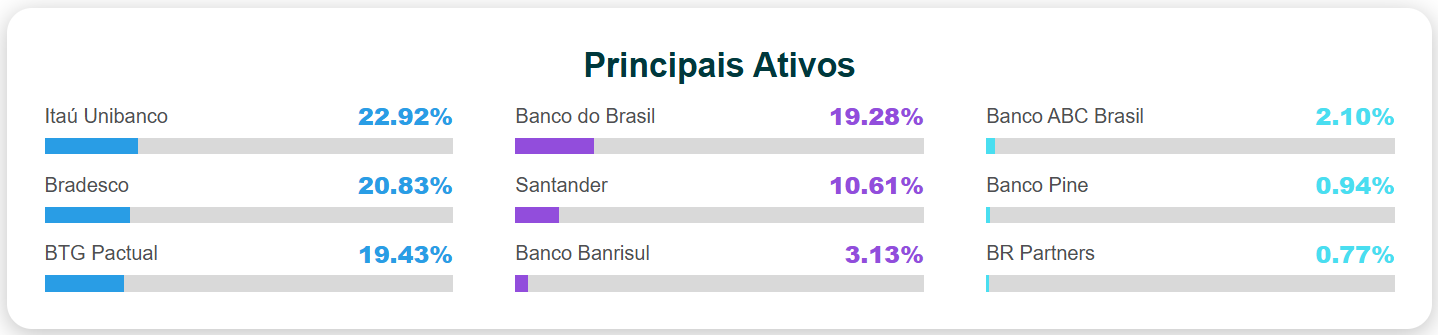
For a stock to be included in the fund, the company must meet specific eligibility criteria set by B3:
-
Be included in the Broad Brazil Index (Índice Brasil Amplo – IBrA B3) on the rebalancing date.
-
Operate directly in the banking segment.
-
Be a listed Brazilian company (BDRs are excluded from the composition).
-
Not be under special legal status, such as judicial recovery (bankruptcy protection).
The weighting of assets within the index is determined by free-float market capitalization (outstanding shares available for trading), excluding the stake held by controlling shareholders. The methodology also establishes weighting caps per company, preventing the portfolio from becoming excessively concentrated in a single bank. Portfolio reviews and rebalancing occur every four months.
Fundamentals and Sector Thesis
The thesis behind BNKS11 is grounded in the structural and financial characteristics of banks in Brazil. According to data gathered by the asset manager in launch materials, major Brazilian financial institutions typically deliver a Return on Equity (ROE) between 15% and 25% per year. This profitability, historically among the highest on B3, is sustained by credit operations with high spreads, revenue diversification (such as insurance and payment services), and a consolidated structure that imposes high barriers to entry for new competitors. Investo also notes that a high interest rate environment tends to support the sector’s profitability.
The long-term outlook also points to the potential for structural credit expansion in the country. The current ratio of credit stock to Brazilian Gross Domestic Product (GDP) remains lower than that recorded in more developed economies, such as the United States, signaling room for growth in banking access and lending volumes in the coming years.
Historical Resilience and Asset Costs
The sector’s track record during cycles of economic instability also underpins the index. The manager highlights that Brazilian banks recorded no aggregate net loss during periods of severe turmoil, navigating the 2008 global financial crisis, the 2015–2016 domestic recession, the Covid-19 pandemic, and recent episodes of stress in the agribusiness sector with strong profit preservation capacity.
In terms of the benchmark index’s historical performance, the B3 Brazil Banking Index accumulated a return of 469% since the start of its historical series in April 2011. Over the same timeframe, the indicator outperformed the Ibovespa, CDI, IPCA inflation, and the IDIV (Dividend Index).
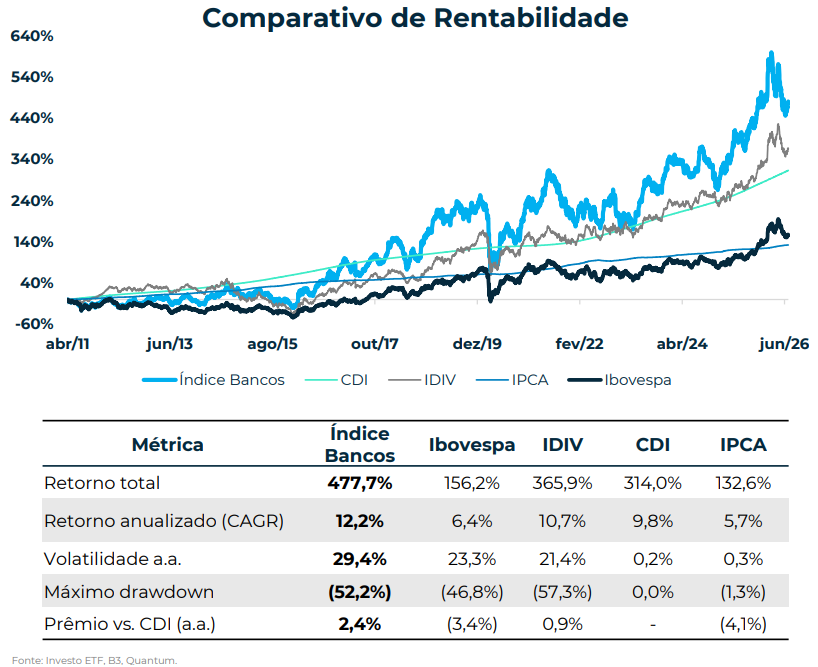
For investors looking to add the asset to their portfolio, BNKS11 enters the market with a management fee of 0.50% per year, expanding options for those seeking sector exposure via index funds in Brazil.


