In his new column, Danilo Moreno, Head of Research at Investo, uses data to argue the importance of investors having a portfolio guided more by structural fundamentals than by predictions and moment-to-moment narratives.
There are many legitimate ways to use ETFs. Some prefer to build a broad allocation and keep it unchanged for decades. Others use sector or thematic ETFs to express specific convictions about the world. Professional managers use ETFs as building blocks in tactical portfolios. All of these approaches are valid, provided they are anchored in a conscious choice, not an illusion. The illusion to avoid in any strategy is believing that we are good at predicting what will happen.
The arithmetic that condemns the average active investor
William Sharpe, winner of the Nobel Prize in Economics, published a short essay in 1991 called “The Arithmetic of Active Management,” which deserves to be read by every investor. The mathematical argument is simple: since the market is, by definition, the sum of all participants, the average return before costs for an active investor is, obligatorily, equal to the average return of a passive investor. After deducting fees and transaction costs, the average active investor must fall below the index. This is not an empirical observation that may or may not hold true. It is a mathematical identity. Consistently generating outperformance over the index requires something difficult to produce at scale: superior information, superior skill, or sustained luck.
Empirical evidence reinforces the point. For over a decade, Morningstar has published a study called Mind the Gap, which compares fund returns with the returns actually captured by investors in those same funds. The difference, known as the behavior gap, measures how much the average investor loses by adjusting their allocation at the wrong time. Edition after edition, the result is similar: investors capture between 1 and 2 percentage points per year less than the fund itself delivered, because they buy after rallies, sell after drops, and churn their portfolio in response to headlines.
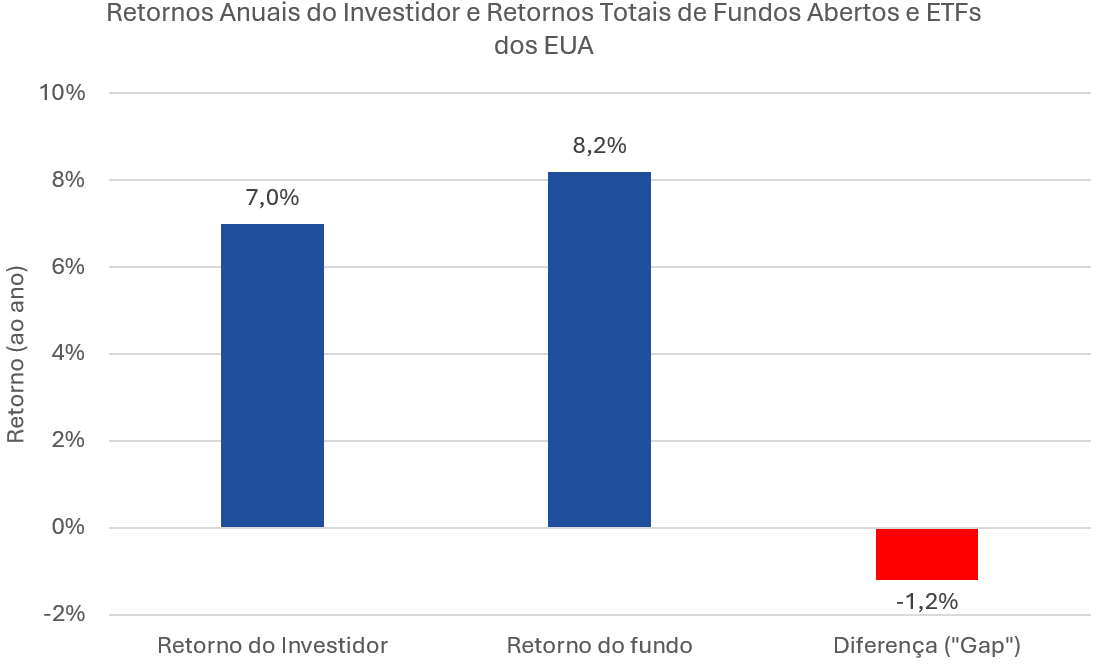
Source: Morningstar. Mind the Gap Study 2025
The combination of these two findings has a direct implication. Systematically beating the market is difficult for mathematical reasons, and even those who find reasonable strategies often lose returns due to their own behavior. This does not condemn every allocation decision. It means that the more a portfolio relies on successive accurate predictions, the more fragile it tends to be. What shifts a portfolio from robust to fragile usually lies less in the type of ETF chosen and more in what justifies the position. An allocation in an S&P 500 ETF backed by a structural thesis on exposure to US companies is a decision. The same position bought because “US interest rates will start falling soon” is a prediction.
What if we built portfolios immune to our own predictions?
In practice, this allows for different uses of ETFs within the same portfolio. WRLD11, which replicates a global stock index, works as a broad allocation block, suitable for those who want low-cost structural equity exposure. Meanwhile, QLBR11, which tracks a multi-factor quality index in the Brazilian market, expresses a more specific thesis: that companies with strong balance sheets and solid profitability tend to perform better over time—a factor premium well-documented in financial literature for decades. The difference from a prediction is that neither position depends on timing the market or predicting the next interest rate move. They are choices about where to be positioned in the long run, not about what will happen next quarter. In both cases, portfolio consistency does not come from the type of ETF, but from the reason the position exists.
In the end, Sharpe’s and Morningstar’s point is not that every portfolio movement is wrong. It is that every portfolio gains in quality when it relies less on predictions. Recognizing this limitation and building a portfolio that continues to function even when predictions fail is usually the most solid way to invest, whether the strategy is passive, factor-based, or tactical.