

In his new column, Samir Kerbage, CIO of Hashdex, comments on recent geopolitical issues and how these episodes reinforce the importance of allocating to crypto assets in portfolios.
In the 2026 Crypto Investment Outlook report, the central theme identified was the rise of the “crypto dollar”, a term that summarizes the growing influence that both stablecoins and Bitcoin exert over the global monetary system. Recently, three milestones highlighted the speed at which this transformation is taking place: stablecoin market capitalization reached a new all-time high, Iran began accepting bitcoin as a toll payment for vessels in the Strait of Hormuz, and legislation for the market structure of digital assets advanced in the United States Congress.
The new buyer of Treasuries
In May, the market value of stablecoins surpassed the US$ 320 billion mark, setting an all-time record. Together, issuers Tether and Circle currently hold a volume of US Treasury bonds (Treasuries) greater than that of several sovereign nations, including Saudi Arabia, Germany, and Mexico. Analysis of these numbers highlights that the crypto infrastructure rails underlying these digital dollars act as a “financial lung”, generating a new and significant source of demand for the US currency. Quietly, the stablecoin ecosystem has converted into one of the largest global buyers of short-term US public debt.
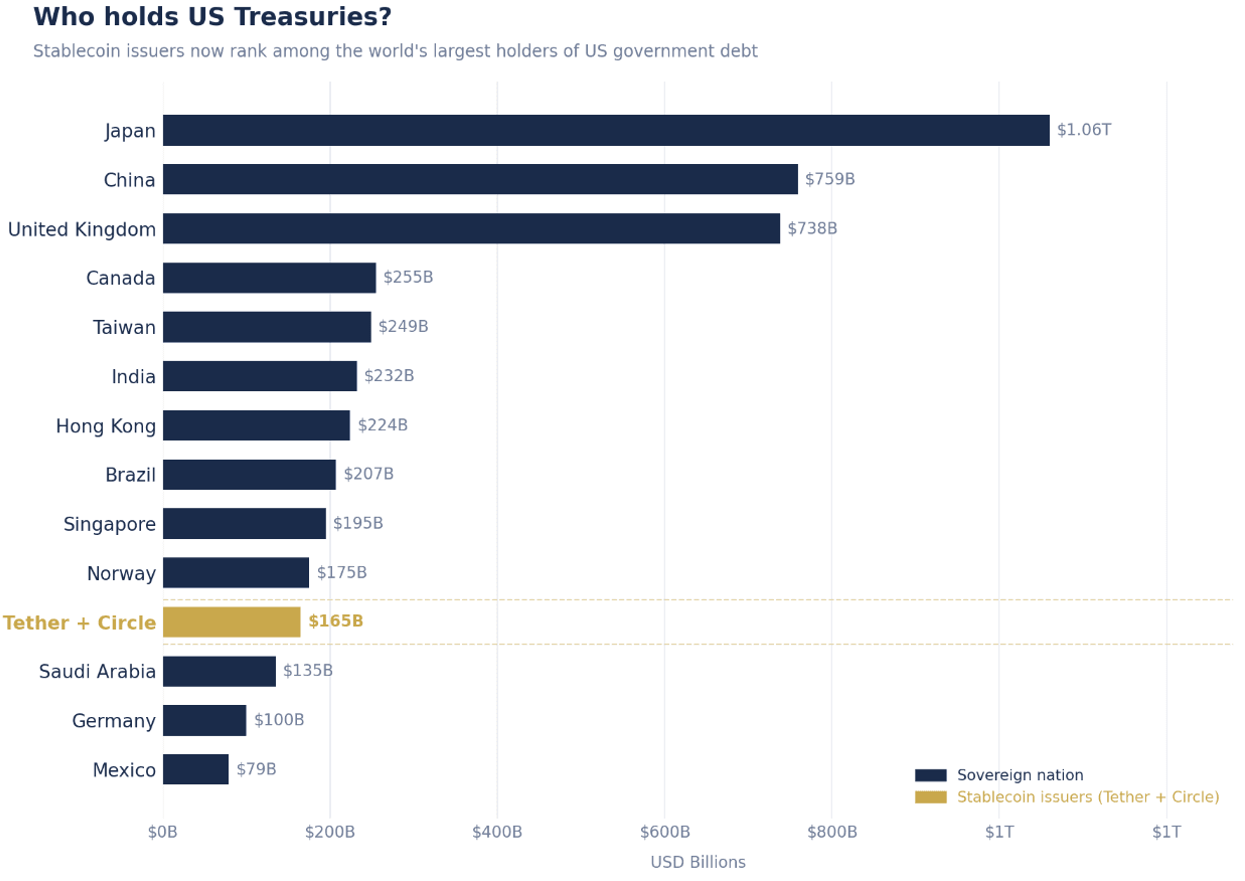
Source: US Treasury TIC data (Nov. 2025); Tether Q4 2025 reserve attestation; Circle USDC reserve reports. Approximate values.
This shift carries strategic relevance. For decades, the petrodollar mechanism, in which oil-exporting countries received payment in dollars and recycled those funds into purchasing Treasuries, served as the anchor supporting dollar hegemony, keeping US financing costs low. However, this traditional engine has been losing momentum: Russia completely withdrew from the system, and China reduced its US treasury holdings from over US$ 1.3 trillion to around US$ 760 billion.
Stablecoins emerge precisely to fill this gap as structural buyers. Under the GENIUS Act, signed into law the previous year, these digital currencies are required to maintain a 1:1 backing in reserves. In practice, this establishes a permanent buyer of US debt operating without political friction, cross-border, and continuously (24 hours a day), supporting projections that the stablecoin market could reach US$ 500 billion within this year.
The neutral reserve asset
In March, Iran formalized a requirement for vessels transiting the Strait of Hormuz to pay a toll that can be denominated in bitcoin. Facing a daily flow of approximately US$ 21 million in crude oil through the region, a sovereign state under severe international sanctions and excluded from the SWIFT system found in bitcoin a neutral financial instrument capable of settling transactions in an acceptable manner for both parties.
This panorama illustrates bitcoin’s role in the new global monetary architecture. Rather than competing directly with the dollar, bitcoin acts as an “emergency connector” or financial bridge, filling gaps that traditional currency cannot reach—especially in commercial transactions between actors who lack mutual trust and do not share the same traditional financial rails. The episode in the Strait of Hormuz stands out as a practical example of this trend, which is expected to repeat in other geopolitical scenarios.
The evolving infrastructure
In the regulatory realm, the advancement of the CLARITY Act in the Senate Banking Committee in May represented considerable bipartisan progress for digital asset market structure. While there is still no certainty regarding the proposal’s definitive enactment into law this year, widespread optimism is observed regarding lawmakers on both sides recognizing the strategic importance of this industry for the economy and for modernizing US financial markets. The structural and statutory clarity brought by this legislation is expected to act as a powerful catalyst for the crypto market in 2026, driving this asset class’s transition from a purely speculative level to an indispensable position in any investment portfolio.
A dilemma for advisors
With the growing integration of digital assets into the global economy, professional allocators face the challenge of designing the best exposure strategy. The natural impulse of many investors is to try to guess which technological path will emerge victorious: Bitcoin, established as a neutral reserve asset, or networks like Ethereum and Solana, which provide the infrastructure and operational rails for stablecoins and tokenization.
Analysts point out, however, that this approach may be misguided. Individual asset selection (stock picking) tends to underperform for most investors, given that the ongoing structural transformation benefits the asset class as a whole. Drawing a historical analogy with mid-1995, at the beginning of the commercial internet era, it was virtually impossible to accurately predict which companies would survive over the long term.
Instead of trying to find the needle in the haystack, the most successful investors were those who bought the “entire haystack”—that is, the market in an aggregate way. For this reason, it is argued that an allocation benchmarked to diversified indices, such as the Nasdaq CME Crypto Index, constitutes the most efficient and prudent path for most investors to gain exposure to this market.

Samir Kerbage is Chief Investment Officer at Hashdex, responsible for global investment strategy, product development, and research. Founding partner of Hashdex, he led the building of the firm’s crypto asset management platform through ETFs, ETPs, and other vehicles. Samir has over 15 years of experience in financial market infrastructure and quantitative trading and holds a degree in Computer Engineering from IME.


